— A Visual Archive of Digital Exhibitions
On collecting, looking, and what disappears
In 2017, I wrote my bachelor thesis at ECAL on digital afterlife — on what happens to our online traces when we die, who is responsible for preserving them, and what it means when they disappear. The conclusion was that responsibility is largely unresolvable. Things vanish because nobody renews the domain, because Flash stopped working, because an institution redesigned its website and didn’t carry the old work forward.
Eight years later, building the Paik Replayed database, I keep running into the same problem.
The Database
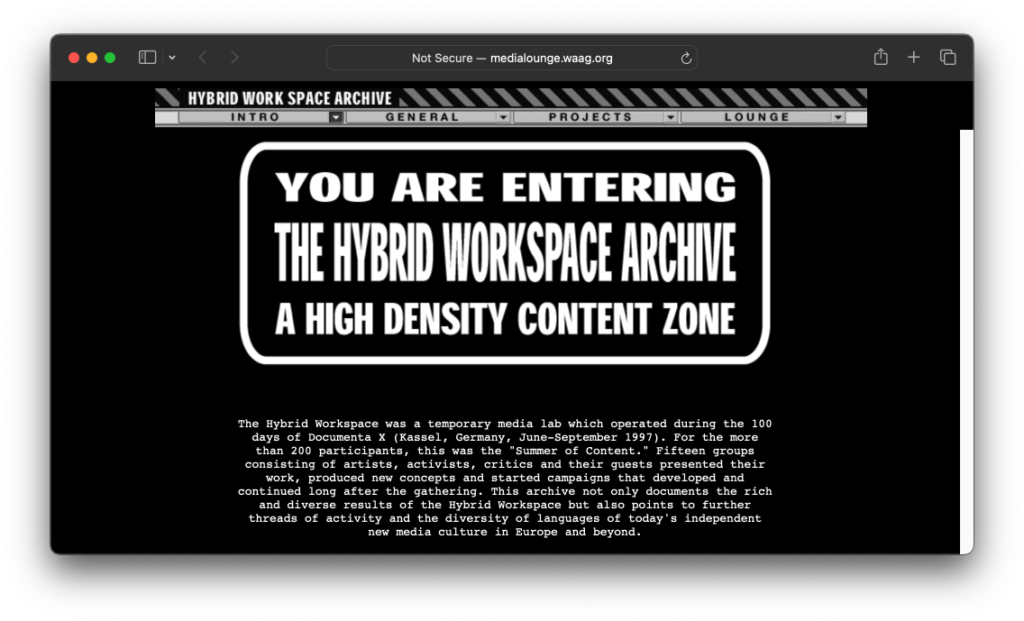
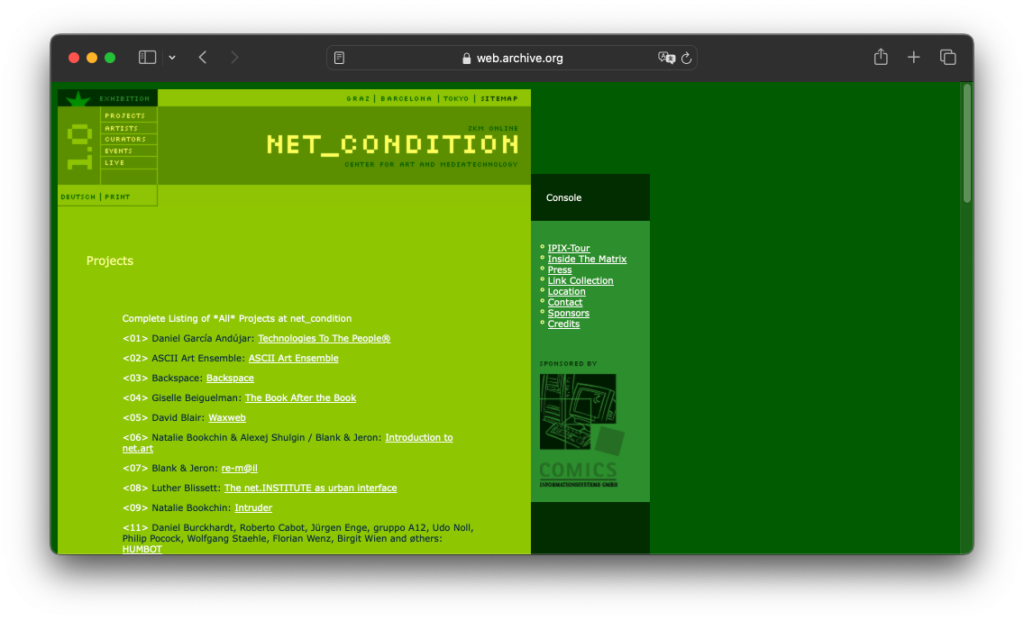
As part of WP1, the Paik Replayed team has built a database of approximately 200 hybrid exhibitions spanning the 1990s to today, currently being prepared for publication as an interactive website. Alongside this, I’ve been collecting visual material for a selection of these cases — screenshots, archived pages, interface recordings, exhibition documentation. To keep things as accurate as possible, I’ve tried to capture each case at the resolution native to its moment: 1024×640 for the 1990s, scaling up through to 1920×1080 for more recent work. Viewing a 1990s interface stretched across a 4K screen tells you nothing about how it was actually experienced. For many cases, there is increasingly not very much left to find. Sites that were live just a year or two ago are already gone. Flash-based interfaces survive only as visual ghosts on the Wayback Machine — you can see the layout, but the interactive layer is lost.
What the Screenshots Reveal
What I didn’t anticipate was how absorbing it would become to simply look. Going back through digital exhibitions decade by decade is not just research — it’s an aesthetic experience. The 1990s interfaces have a particular quality: raw, experimental, genuinely curious about what the screen could be. There were no conventions yet. Artists and curators were inventing the language as they went.
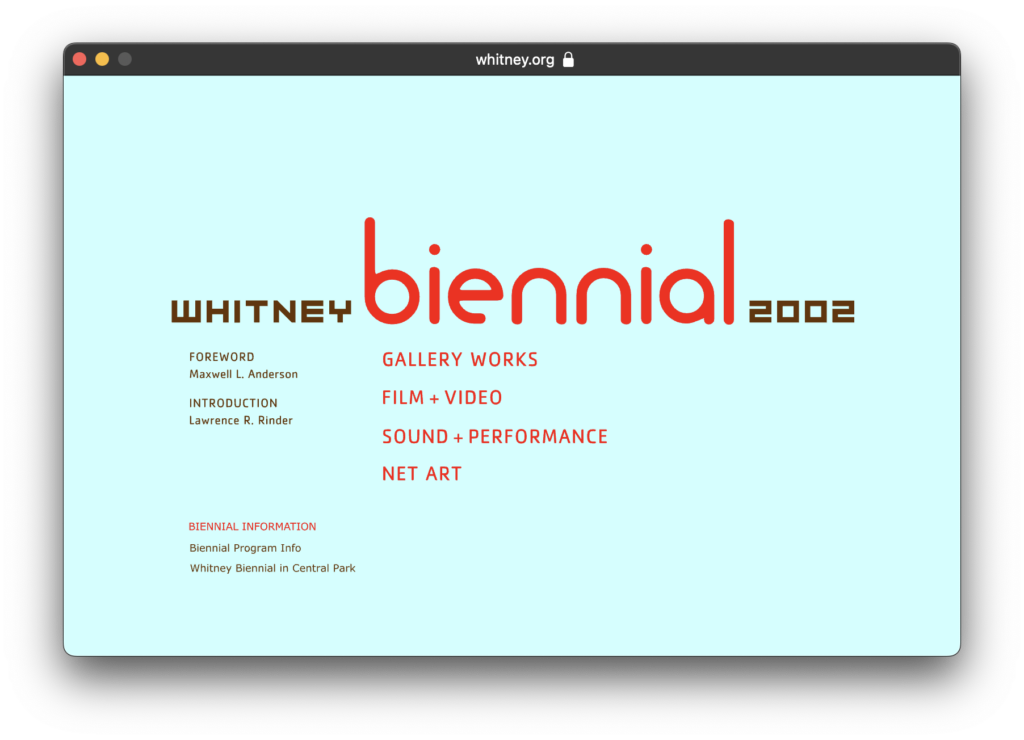
The mid-2000s brought Flash at its peak — kinetic, layered, often baroque. Then the smartphone shift compressed everything into responsive grids and scrolling pages. Each era has its own visual grammar, and what keeps striking me is how clearly you can see the tools thinking through the designers. Dreamweaver has a look. Flash has a look. Unity has a look. These aren’t just stylistic choices — they’re the direct imprint of what was technically possible at each moment.
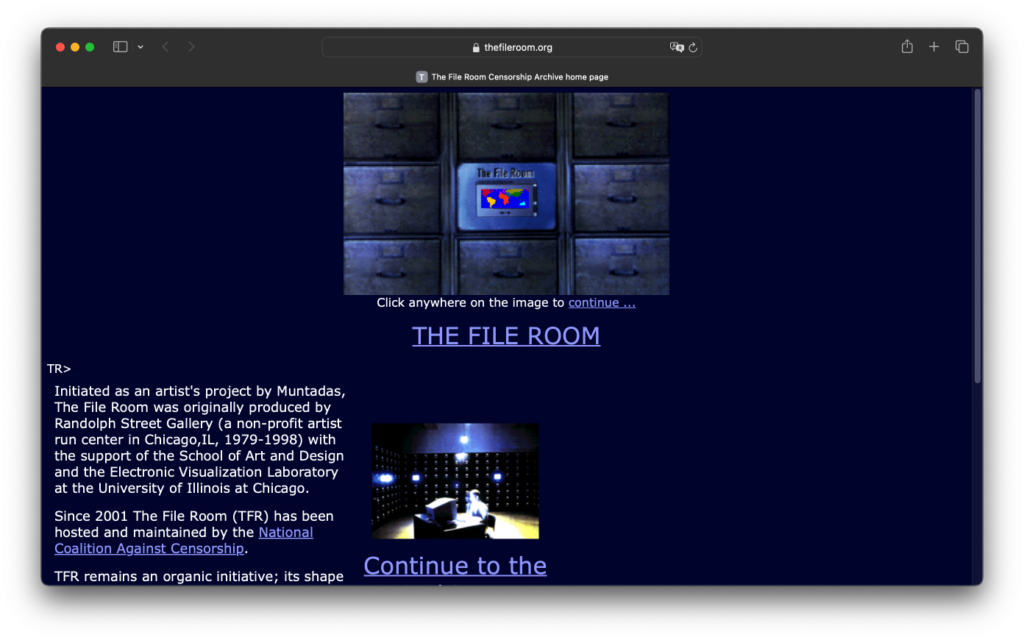
The File Room (1994) by Muntadas is one of the earliest examples of net art built as a living archive—a censorship database that invited public contributions. It is still accessible today at thefileroom.org, which itself is a kind of exception: most works from this era are not.
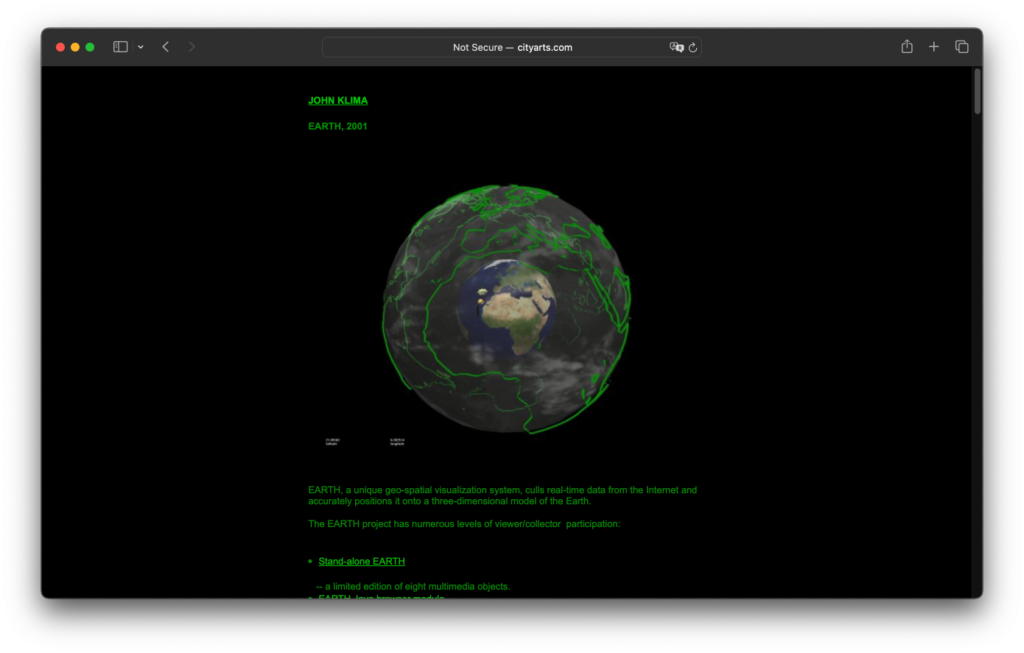
Works like John Klima’s EARTH (2001) — a real-time geo-spatial visualization pulling live data — technically still load, but the live data layer they depended on is gone. The shell survives. The work doesn’t.
Who Is Responsible?
Earlier this month, Patrick Keller — PI of the Paik Replayed project — shared a Wired article by Kate Knibbs (April 13, 2026) on LinkedIn about the Wayback Machine being cut off by major news outlets. “What we were discussing the other day,” he wrote, tagging me. The timing felt apt.
My 2017 thesis concluded that responsibility for digital traces is diffuse to the point of being unassignable. At a larger scale, the same structure applies here. Museums redesign their websites. Funding ends. Developers move on. The Wayback Machine captures surfaces, not behavior. Rhizome’s Net Art Anthology is one of the rare serious institutional responses — restoring and re-presenting net art works through dedicated preservation infrastructure. But projects like that require significant resources and remain the exception.
The situation is not improving. As the open web becomes increasingly difficult to archive — for reasons both technical and commercial — what gets preserved is narrowing. News outlets are cutting off access to archiving tools, including the Wayback Machine itself, to protect their content from mass scraping. Public information as a common good is quietly disappearing, and the trails back to original sources go cold.
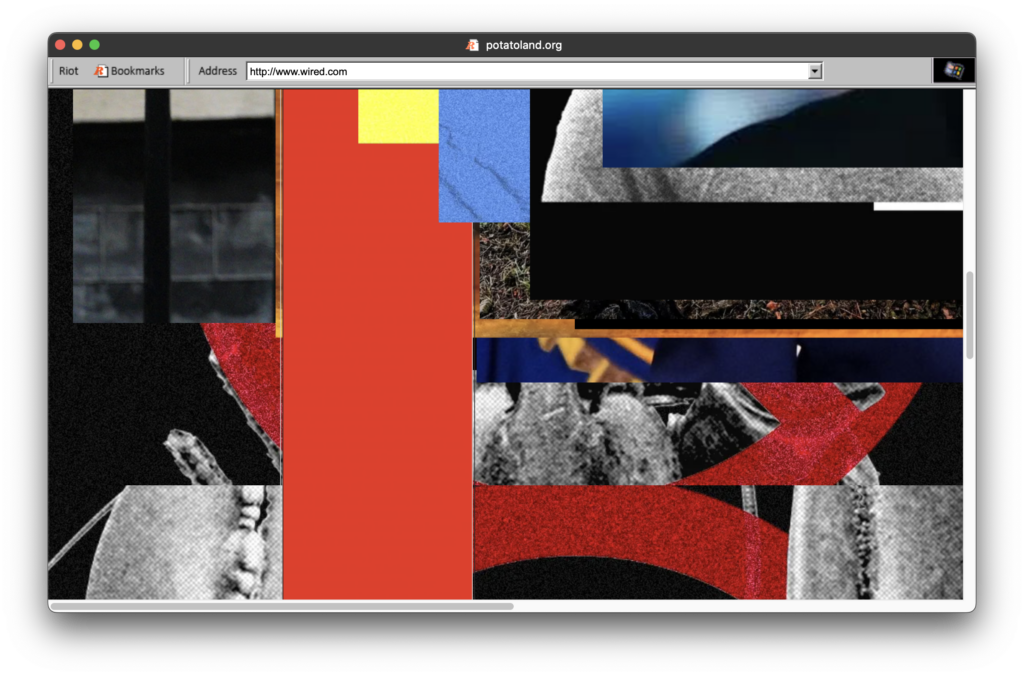
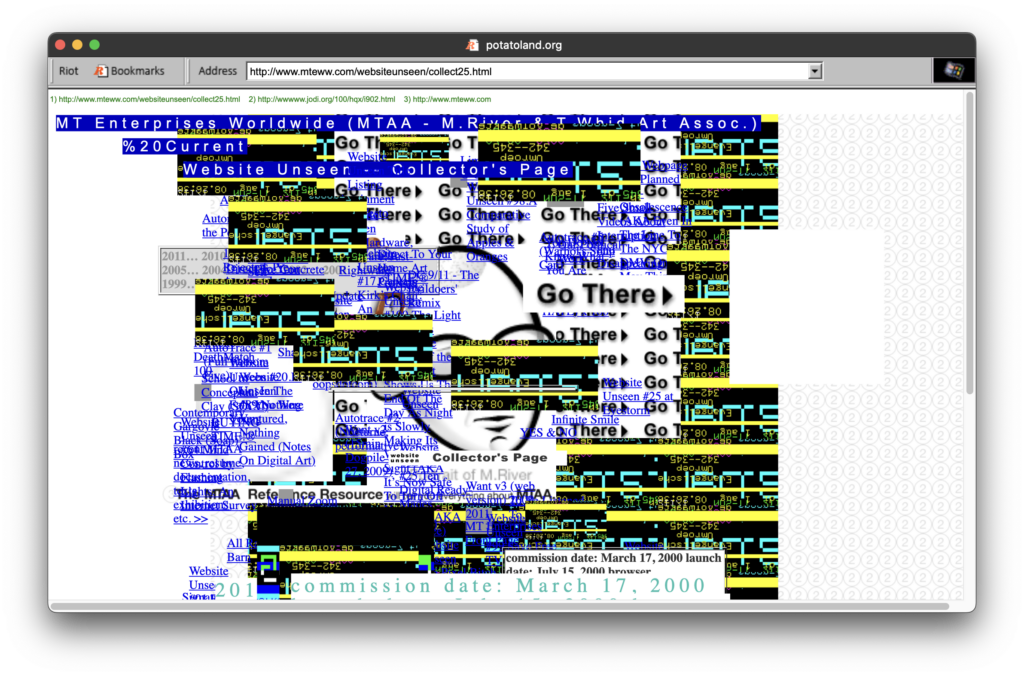
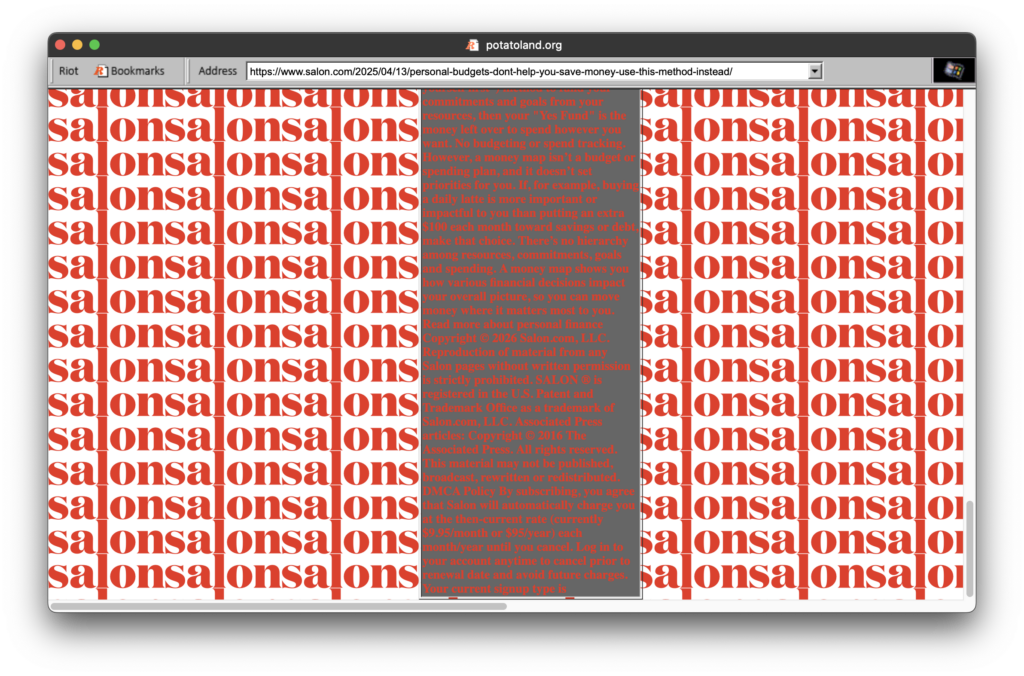
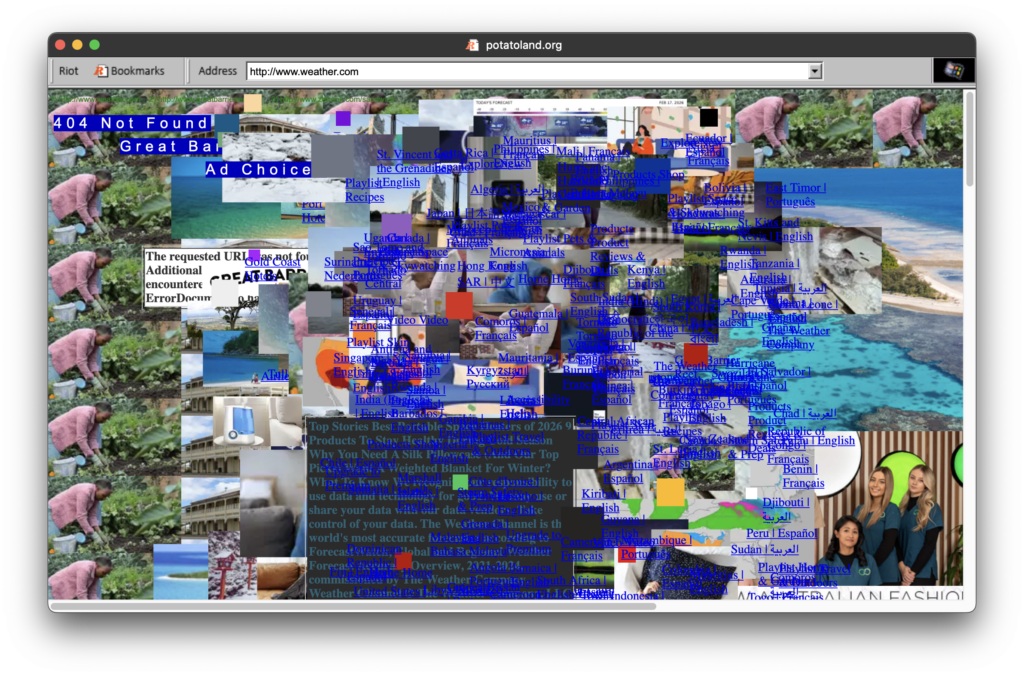
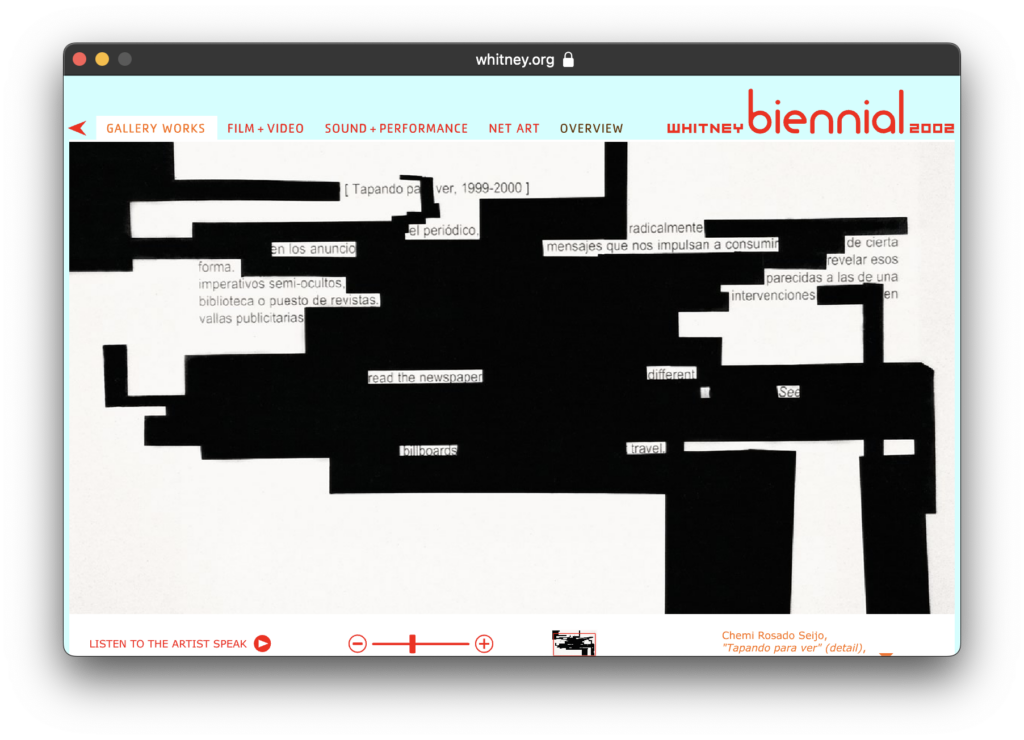
Mark Napier’s Riot (1999) makes this concrete in a different way. A net art browser that blends web pages together as users surf, Riot was shown in the 2002 Whitney Biennial — the same year as the exhibition above. Running it today against contemporary websites produces something unintended and vivid: the aesthetic logic of 1999 colliding with the visual infrastructure of 2026.